
DOWNLOAD the newest ExamPrepAway CKS PDF dumps from Cloud Storage for free: https://drive.google.com/open?id=1NVEoEX-jx_HfxdW24SGZk2NCbDhuLKEI
ExamPrepAway makes your CKS exam preparation easy with it various quality features. Our CKS exam braindumps come with 100% passing and refund guarantee. ExamPrepAway is dedicated to your accomplishment, hence assures you successful in CKS Certification exam on the first try. If for any reason, a candidate fails in CKS exam then he will be refunded his money after the refund process. Also, we offer one year free updates to our CKS Exam esteemed user, these updates are applicable to your account right from the date of purchase. 24/7 customer support is favorable to candidates who can email us if they find any ambiguity in the CKS exam dumps, our support will merely reply to your all Certified Kubernetes Security Specialist (CKS) exam product related queries.
Linux Foundation CKS certification is an advanced-level certification for Kubernetes administrators who want to demonstrate their expertise in securing container-based applications and Kubernetes platforms. It is a performance-based exam that evaluates the candidate's ability to secure a Kubernetes cluster using industry best practices. Obtaining the CKS certification can help you stand out in a competitive job market and demonstrate your commitment to staying up-to-date with the latest Kubernetes security trends and best practices.
To take the CKS Certification Exam, candidates must have a valid CNCF (Cloud Native Computing Foundation) CKA (Certified Kubernetes Administrator) certification, which demonstrates their proficiency in Kubernetes administration. Candidates must also have experience working with Kubernetes in production environments and have a good understanding of Linux command-line tools and utilities.
>> CKS Latest Braindumps Free <<
We are willing to provide all people with the demo of our CKS study tool for free. If you have any doubt about our products that will bring a lot of benefits for you. The trial demo of our CKS question torrent must be a good choice for you. By the trial demo provided by our company, you will have the opportunity to closely contact with our CKS Exam Torrent, and it will be possible for you to have a view of our products. More importantly, we provide all people with the trial demo for free before you buy our CKS exam torrent and it means that you have the chance to download from our web page for free; you do not need to spend any money.
NEW QUESTION # 35
SIMULATION
Context
For testing purposes, the kubeadm provisioned cluster 's API server
was configured to allow unauthenticated and unauthorized access.
Task
First, secure the cluster 's API server configuring it as follows:
. Forbid anonymous authentication
. Use authorization mode Node,RBAC
. Use admission controller NodeRestriction
The cluster uses the Docker Engine as its container runtime . If needed, use the docker command to troubleshoot running containers.
kubectl is configured to use unauthenticated and unauthorized access. You do not have to change it, but be aware that kubectl will stop working once you have secured the cluster .
You can use the cluster 's original kubectl configuration file located at etc/kubernetes/admin.conf to access the secured cluster.
Next, to clean up, remove the ClusterRoleBinding
system:anonymous.
Answer:
Explanation:
See the Explanation below for complete solution
Explanation:
1) SSH to control-plane node
ssh cks000002
sudo -i
2) Edit API Server static pod manifest
API server in kubeadm runs as a static pod.
vi /etc/kubernetes/manifests/kube-apiserver.yaml
3) Apply required API Server security settings
3.1 Forbid anonymous authentication
Find command: section and ensure this line exists:
- --anonymous-auth=false
3.2 Use authorization mode Node,RBAC
Ensure exactly this line exists (and no AlwaysAllow):
- --authorization-mode=Node,RBAC
❌ Remove if present:
- --authorization-mode=AlwaysAllow
3.3 Enable admission controller NodeRestriction
Find --enable-admission-plugins and ensure NodeRestriction is included.
Correct example:
- --enable-admission-plugins=NodeRestriction
If other plugins already exist, append NodeRestriction, e.g.:
- --enable-admission-plugins=NamespaceLifecycle,ServiceAccount,NodeRestriction
4) Save file and let kubelet restart API server
Just save and exit (:wq)
Kubelet will automatically restart the API server pod.
5) Switch kubectl to secured config
Current kubectl will stop working after API server hardening.
export KUBECONFIG=/etc/kubernetes/admin.conf
Verify access:
kubectl get nodes
6) Remove insecure ClusterRoleBinding
Delete system:anonymous binding:
kubectl delete clusterrolebinding system:anonymous
Verify removal:
kubectl get clusterrolebinding | grep anonymous
(no output = correct)
7) Quick validation (optional but fast)
API server flags check:
grep -n "anonymous-auth" /etc/kubernetes/manifests/kube-apiserver.yaml
grep -n "authorization-mode" /etc/kubernetes/manifests/kube-apiserver.yaml grep -n "NodeRestriction" /etc/kubernetes/manifests/kube-apiserver.yaml
NEW QUESTION # 36
SIMULATION
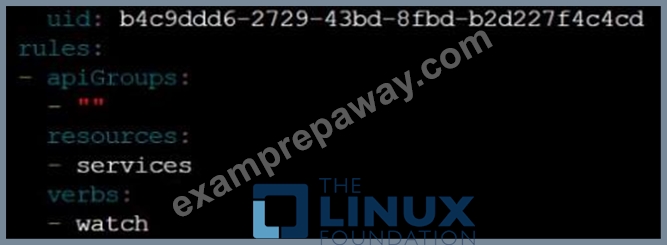
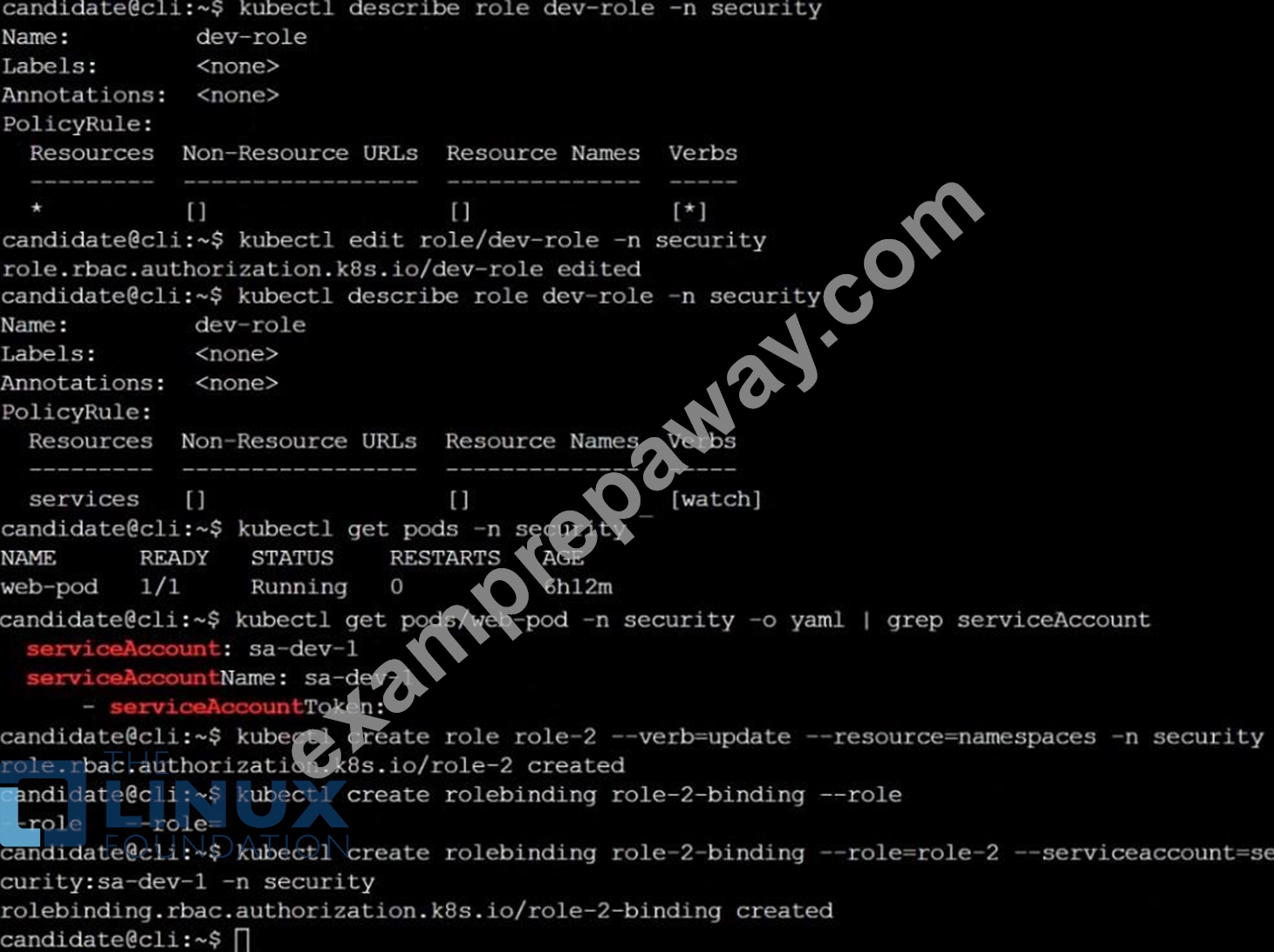
Given an existing Pod named nginx-pod running in the namespace test-system, fetch the service-account-name used and put the content in /candidate/KSC00124.txt Create a new Role named dev-test-role in the namespace test-system, which can perform update operations, on resources of type namespaces.
Create a new RoleBinding named dev-test-role-binding, which binds the newly created Role to the Pod's ServiceAccount ( found in the Nginx pod running in namespace test-system).
Answer:
Explanation:
See the Explanation belowExplanation: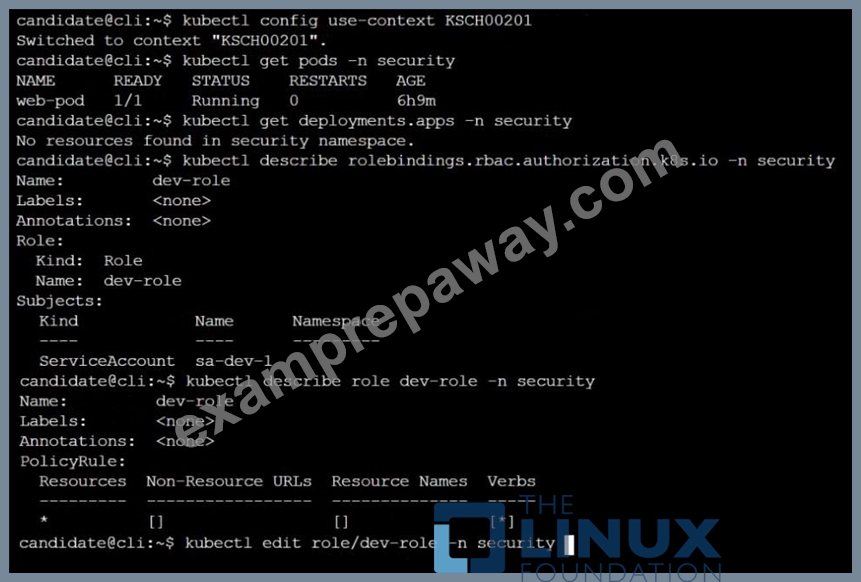
NEW QUESTION # 37
Create a PSP that will only allow the persistentvolumeclaim as the volume type in the namespace restricted.
Create a new PodSecurityPolicy named prevent-volume-policy which prevents the pods which is having different volumes mount apart from persistentvolumeclaim.
Create a new ServiceAccount named psp-sa in the namespace restricted.
Create a new ClusterRole named psp-role, which uses the newly created Pod Security Policy prevent-volume-policy Create a new ClusterRoleBinding named psp-role-binding, which binds the created ClusterRole psp-role to the created SA psp-sa.
Hint:
Also, Check the Configuration is working or not by trying to Mount a Secret in the pod maifest, it should get failed.
POD Manifest:
apiVersion: v1
kind: Pod
metadata:
name:
spec:
containers:
- name:
image:
volumeMounts:
- name:
mountPath:
volumes:
- name:
secret:
secretname:
Answer:
Explanation:
apiVersion: policy/v1beta1
kind: PodSecurityPolicy
metadata:
name: restricted
annotations:
seccomp.security.alpha.kubernetes.io/allowedProfileNames: 'docker/default,runtime/default' apparmor.security.beta.kubernetes.io/allowedProfileNames: 'runtime/default' seccomp.security.alpha.kubernetes.io/defaultProfileName: 'runtime/default' apparmor.security.beta.kubernetes.io/defaultProfileName: 'runtime/default' spec:
privileged: false
# Required to prevent escalations to root.
allowPrivilegeEscalation: false
# This is redundant with non-root + disallow privilege escalation,
# but we can provide it for defense in depth.
requiredDropCapabilities:
- ALL
# Allow core volume types.
volumes:
- 'configMap'
- 'emptyDir'
- 'projected'
- 'secret'
- 'downwardAPI'
# Assume that persistentVolumes set up by the cluster admin are safe to use.
- 'persistentVolumeClaim'
hostNetwork: false
hostIPC: false
hostPID: false
runAsUser:
# Require the container to run without root privileges.
rule: 'MustRunAsNonRoot'
seLinux:
# This policy assumes the nodes are using AppArmor rather than SELinux.
rule: 'RunAsAny'
supplementalGroups:
rule: 'MustRunAs'
ranges:
# Forbid adding the root group.
- min: 1
max: 65535
fsGroup:
rule: 'MustRunAs'
ranges:
# Forbid adding the root group.
- min: 1
max: 65535
readOnlyRootFilesystem: false
NEW QUESTION # 38
You suspect that the Kubernetes binaries on your cluster nodes may have been tampered with. Implement a process to verify the integrity of the binaries and identify any potential compromises.
Answer:
Explanation:
Solution (Step by Step):
1. Establish a known-good baseline: Obtain known-good copies of the Kubernetes binaries from a trusted source, such as the official Kubernetes release page or your distribution's package repository.
2. Calculate checksums: Calculate the SHA-256 checksums of the known-good binaries and the binaries on your nodes.
bash
sha256sum /usr/bin/kubeadm lusr/bin/kubelet 'usr/bin/kubectl
3. Compare checksums: Compare the checksums of the binaries on your nodes with the checksums of the known-good binaries. Any discrepancies indicate potential tampering.
4. Inspect binaries for modifications: If checksum mismatches are found, use tools like 'diff or 'cmp' to compare the suspect binaries with the known- good binaries to identify specific modifications.
5. Analyze system logs: Review system logs, such as audit logs and syslog, for any suspicious activity related to the Kubernetes binaries or processes.
6. Reinstall binaries from a trusted source: If tampering is confirmed, reinstall the Kubernetes binaries from a trusted source.
7. Investigate the root cause: Conduct a thorough investigation to determine the root cause of the tampering and take steps to prevent future compromises. This may involve reviewing access controls, network security, and security monitoring practices.
NEW QUESTION # 39
Service is running on port 389 inside the system, find the process-id of the process, and stores the names of all the open-files inside the /candidate/KH77539/files.txt, and also delete the binary.
Answer: A
NEW QUESTION # 40
......
Contending for the success fruit of CKS exam questions, many customers have been figuring out the effective ways to pass it. And that is why we have more and more costomers and everyday the hot hit and high pass rate as well. It is all due to the advantage of our useful CKS practice materials, and we have these versions of our CKS study materials for our customers to choose according to their different study habbits:the PDF, the Software and the APP online.
CKS Valid Exam Test: https://www.examprepaway.com/Linux-Foundation/braindumps.CKS.ete.file.html
DOWNLOAD the newest ExamPrepAway CKS PDF dumps from Cloud Storage for free: https://drive.google.com/open?id=1NVEoEX-jx_HfxdW24SGZk2NCbDhuLKEI